
How We Turned a 2% Used Quran Planner Into a Feature Users Love


Sometimes, the best product improvements begin with a simple question: Why aren’t people using this?
That question led the Greentech product and design team to rethink one of the long-standing features in the Al Quran app: the Quran Planner.
For years, the Planner was a core feature of the app. But the numbers told a different story. Fewer than 2% of users were using it, while our benchmark for keeping a feature was at least 5%.
The feature had also received little major improvement for four or five years. Its interface felt outdated, and new users often opened the Planner only to find an empty screen with no clear idea of where to begin.
So the team decided it was time to take another look.
The Problem Wasn’t Just the Design
The original Planner was mainly built around one goal: helping users complete the Quran from beginning to end.
Users could create a plan, choose how many days we wanted to take, and track their progress.
That was useful, especially during Ramadan when many Muslims aim to complete the Quran. In fact, analytics showed that the vast majority of existing Planner users were creating plans to complete the Quran during Ramadan.
But the team had a bigger goal in mind. For more than a year, we had been thinking about how the Quran app could help Muslims understand the Quran better, not simply read it from cover to cover.
Reading the entire Quran is a beautiful and important goal. But finishing the Quran and understanding the Quran are not necessarily the same thing.
The team realized that the Planner could become a bridge between the two.
Instead of simply asking users, “How quickly do you want to finish the Quran?”, the feature could help answer a more important question:
“Where should I start if I want to understand the Quran?”
Giving Users a Path Instead of an Empty Screen
One of the biggest problems with the old Planner was the lack of direction. A new user would see an empty page and have to create a plan from scratch. We had to decide what to read, how much to read, and how many days to spend on it.
For someone who already knows what we want to do, that might be fine. But what about someone who wants to understand the Quran but doesn’t know where to start?
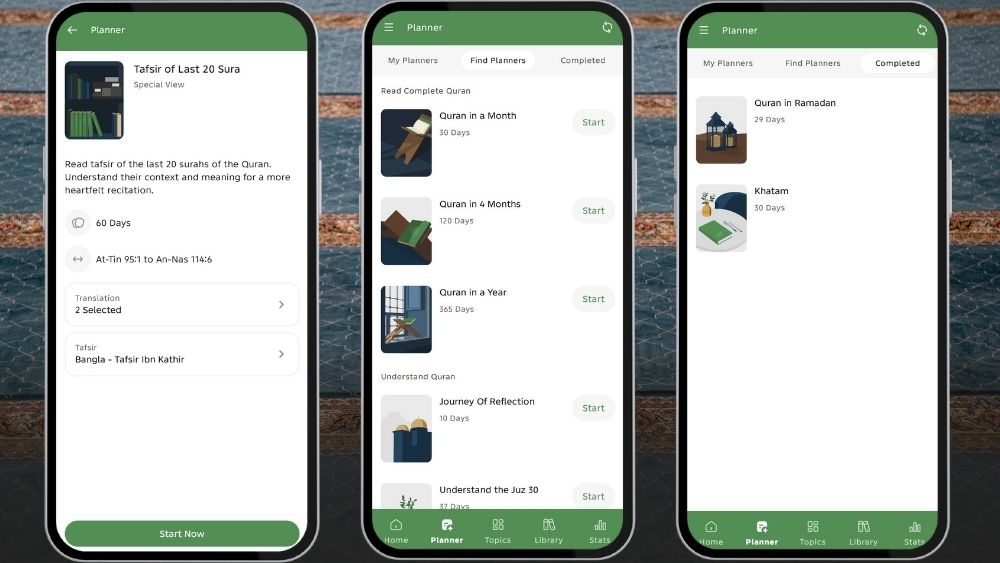
The new Planner was designed around this idea of guidance. Instead of starting with an empty page, users now see ready-made plans.
For Quran completion, there are different options, including:
- Quran in a Month
- Quran in Four Months
- Quran in a Year
- Quran in Ramadan
But the bigger change is the new Understand Quran section.
It includes scholar-created plans designed to give users a structured starting point for their Quran learning journey. These include plans focused on understanding Juz 30, exploring selected important verses, and studying Tafsir of the final surahs.
The goal is simple: users don’t have to figure everything out alone. We can choose a path and start.
A Planner That Works Around the User
The team also discovered another limitation in the old design. All planner progress was tied closely to the main Quran reading view. This became restrictive when users wanted to follow more than one plan.
For example, someone might want to study the Tafsir of Surah Al-Fatihah while also following a translation-based plan for another part of the Quran.
The new design gives each planner its own reading experience.
A planner can have its own translation, reading settings, Mushaf view, and other preferences without changing the user’s main Quran reading experience.
This makes it possible to have multiple learning journeys at the same time.
Letting Data Guide the Decisions
The redesign wasn’t based only on opinions or assumptions. The team went back to analytics to understand how people were actually using the feature.
We found that Quran completion plans, particularly the one-month plan, were by far the most common. That insight helped the team keep Quran completion prominent rather than simply removing the old feature.
The goal wasn’t to replace what users already valued. It was to build on it. The team also used the opportunity to introduce seasonal plans.
Before Ramadan, we created a Ramadan Planner that automatically adjusts the reading schedule based on the remaining days of Ramadan. Whether someone starts on the first day or later in the month, the plan distributes the remaining Quran accordingly.
Then came the Journey of Reflection, a Shawwal plan built around motivational Quranic verses selected by a scholar.
The idea was thoughtful: Ramadan may end, but our relationship with the Quran shouldn’t.
Designing Something Meaningful Takes Time
The redesign wasn’t completed overnight. The entire end-to-end design process took roughly three months, with the Planner becoming the designer’s main focus for the quarter.
Even the illustrations required experimentation. The design team tried abstract illustrations, photographs, and different visual approaches. Many didn’t fit the existing design system or required too much space.
Eventually, we found a creative workflow using Unsplash for visual composition, Gemini to simplify photographs into illustrations, and Figma to redraw and apply the app’s existing color palette.
AI helped speed up parts of the process, but it didn’t replace the designer. The designer still had to decide what worked, simplify the visuals, maintain consistency, and make sure everything fit the product.
And that reflects something important about building good products: AI can help you move faster, but understanding the user still comes first.
From Tracking Progress to Guiding a Journey
The new Planner is more than a redesigned interface. It represents a shift in thinking.
The old Planner primarily helped users finish the Quran. The new Planner aims to help users read, understand, and grow through the Quran.
It still supports those who want to complete the Quran in a month, four months, or a year. But it also gives users a structured way to explore Tafsir, translations, selected verses, and other scholar-guided learning journeys.
Early results were encouraging. The Planner creation event was triggered more than 113,000 times during the period reviewed, while the Journey of Reflection plan also performed better than expected. But the real success is bigger than the numbers.
A feature once used by fewer than 2% of users is now helping more people find a structured path to engage with and understand the Quran. It was a reminder that good design starts with understanding what people actually need.


